Unfortunately, it seems that only through big tragedies we are able to gain perspective on our lifes, and are reminded how extremely lucky we are that our families are healthy and safe.
As we were talking about this during lunch, our twitter stream showed a couple of great help initiatives from the Mac and iPhone communities. The guys at OmniGroup are donating more than $45,000; Mike Piatek-Jimenez will donate all proceeds from Seasonality for the rest of the month; Daniel Jalkut and others are calling for action on an initiative being put together by Justin Williams. We decided to adhere to Justin's idea, but we thought we'd also like to do something by ourselves.
Although we are not able to provide such a substantial up-front help as OmniGroup's, we thought we could just keep half of our income from the sales of Sketches (versions 1 and 2) during one week, and donate the other half to a non-profit aid organization. If you like our products and would like to help us on this, please consider buying Sketches or Sketches 2 now.
On a personal note - since we created LateNiteSoft, I have frequently considered how lucky I am to enjoy the best job I could ever dream of. However, I also get anxious or sad about work issues or personal situations, and those feelings sometimes obscure the rest. I will try to approach the future with a better scale, to be permanently aware -and not just during a crisis- of how mundane and small my problems really are. I hope this resolution, my only one for 2010, will make life a bit easier for those around me.
Update: We finally donated $1510 to Save the Children. Thanks very much everyone for helping us with this!

Latenitesoft: Mac & iOS Applications. Our blog.
Showing posts with label Apple. Show all posts
Showing posts with label Apple. Show all posts
Thursday, January 14, 2010

Saturday, July 04, 2009
From Orange to Apple
Maybe the title should have been “From an Orange Executive to an Apple Indie Developer”, or simply put “Learnings After One Year as Indie”. Basically, I wanted to explain how I came to make one of the biggest changes in my life, what the motivations were, and some of the things I did learn throughout the process.
So, at 39, I was a reasonably successful executive at Orange, the French telecommunications company owned by France Telecom. At that time, France Telecom had more than 200,000 employees, more than 3,000 of them in Spain. I was one of them, one of those called “Top 100”; a director in charge of Web operations, leading a group of nearly 50 people. I had a nice salary and nice benefits too.
I worked for Orange during 8 years. Prior to that, I had been working for other multinational companies, always related to technology, which was, and still is, my passion. That is also the reason why I majored in computer science. However, soon after I started working, it became clear that I could not make a living creating software, at least not the software that I wanted to make. Soon after that, I got a masters degree in business administration, and began a managerial career that some years later took me to Orange.
During my time at Orange, I started Cocoa development, a bit as a hobby. I had been developing applications, mostly games, since I was 14. Being new to the Mac, I wanted to see what Cocoa was about. At the same time, Pedro, who also worked for the same employer, had this idea about making a universal binary stripper. So he went ahead and made the first implementation of his idea as simple shell script. It worked just fine. We had been working together several years, and we knew each other quite well. When he showed it to me, I told him that I wanted to make it more “Mac-like”. I, then, created a user interface that showed the application list and an icon for the architecture. Finally, Pedro integrated the guts of his script into Cocoa. It was the birth of Xslimmer. To our surprise, Xslimmer's popularity began to grow, and with it, so did its sales.
Months later, around August 2007, we created Sketches. Those were the jailbreak days for us, as there was no official support from Apple for third party applications. Interest for it skyrocketed, and for every new update there were hundreds of thousands of downloads. Some months later, Apple announced the SDK and the App Store. It was clear that there was an opportunity.
So, my day job, family and other responsibilities were taking most of my time. I felt stressed, and drank a lot of coffee. I had a gut feeling that the time was coming to make a change. As opposed to what was clear to me in the early 90‘s, Xslimmer had taught me that it was possible to make a living on selling software that I had created. And the App Store was coming.
At that same time, Orange was starting to feel the pounding from the world's financial and economical crisis, and had bad forecasts for the future. As it had happened in several occasions before, and in preparation for the crisis, there was a management reshuffle. I was offered the IT Project Management Direction. The job was for sure interesting, but my head was somewhere else. I needed to pursue my dream of creating my own software company, one that would make software I wanted, and I knew that the time was then.
I left Orange, on July 4th, 2008. Exactly one week before the App Store went life.
After one year there are a few things I have learned, that might deserve sharing:
App Store success is temporary. I compare it to the music industry. While you are on the top chart, you sell; once you are out, your sales level is much, much lower. In our case, Sketches did great for a couple of weeks, reaching Top 12 in the US for a while.
Apple listens, but it takes them a while to react. During the iPhone SDK beta testing, we wrote several bug reports - it sometimes took several weeks, but they were all answered to, and most fixed. Once the App Store was live, I wrote an article a while back that included several suggestions for improving the App Store. Most of the things that I wanted changed are now changed. For example, allowing only users of the application to voice an opinion and rating about it.
On marketing, experiment and follow your instinct. During this year we tried different things that did not work out. From joining other developers to create an “Apps Gems” site, to purchasing online advertisement. We were new to those types of actions. However, simpler, and cheaper, tactics did work out quite well. Twittering, blogging or simple press releases did much more than any expensive advertisement. I obviously need to learn more on this.
Get help for your paperwork. Administrative stuff and taxes is unavoidable. You just have to do it. We have a small accounting company that takes care of filling up the necessary forms and that keeps the accounting information for us, but most of the work, you still have to do. You have to process those PayPal reports, you have to process those iTunes Connect Financial reports, you have to scan all the invoices you receive, and so on. But having help from a third party places some routine to it, and ensures that you will meet the necessary deadlines.
It is not all fun, but automation helps. You cannot start new products all the time. You have to take care and nurture your existing products, so that your customers realize you actually take them seriously and are committed to making them better and better. Your customer base demands time too. Customer support takes a good chunk of your time. The more products and the more sales, the higher the number of customer support requests. I would say that around 2% of sales translate into customer support requests. Most are very simple, but some are not. The solution is to try to automate things as much as possible. From self service (recover your license) to email templates, all helps.
Working at home is harder than I thought it would be. This is not because of a lack of discipline, but, in my case, the environment is really noisy and busy during the day. I found myself trying to work while being interrupted. Being used to code at night, this was really hard for me. We ended up renting a small office, just a few days ago.
There are more things in life than just work. For a couple of months, I believed Pedro had lost interest in our little software start-up. One day he explained to me that he was ending his 15-year-old marriage. It took a while for him to reorient his life, and, as a result, we deviated from our scheduled workplan, and part of our initial inertia was lost. However, now I try to spend more quality time with my family, while keeping a more flexible philosophy about how to spend my time. For example, last week I took the afternoon off and spent it having fun with my family. What's more, I did not feel guilty or time pressured about it.
You can do all those things that you never could. Now there is no excuse. It is just a question of organizing yourself. In my case, I wanted to lose weight. That is hard to do when you spend a lot of time traveling around, eating sandwiches at meetings or while preparing presentations at 2AM. But once you are the owner of your time, it is. I lost 20Kg (44 pounds) from September to December last year.
So, now what? Well, when I think of what I want to accomplish in the future, I do not think of creating a huge company with many employees, controlling the world’s software market. My objective at this point in time is to create a company similar to Panic or the Omnigroup. These companies keep the indie spirit, while having some specialization and some size, so they produce quality products while providing a quality service, as their employees can dedicate most of the time to what they do best.
So, for LateNiteSoft 2.0, and if our numbers allow for it, my intention is to hire an enthusiast support/webmaster/marketing person, as the first non-founder employee. Then, where we go from there remains to be seen, but I am sure it is going to be both interesting and fun.
My background
So, at 39, I was a reasonably successful executive at Orange, the French telecommunications company owned by France Telecom. At that time, France Telecom had more than 200,000 employees, more than 3,000 of them in Spain. I was one of them, one of those called “Top 100”; a director in charge of Web operations, leading a group of nearly 50 people. I had a nice salary and nice benefits too.
I worked for Orange during 8 years. Prior to that, I had been working for other multinational companies, always related to technology, which was, and still is, my passion. That is also the reason why I majored in computer science. However, soon after I started working, it became clear that I could not make a living creating software, at least not the software that I wanted to make. Soon after that, I got a masters degree in business administration, and began a managerial career that some years later took me to Orange.
During my time at Orange, I started Cocoa development, a bit as a hobby. I had been developing applications, mostly games, since I was 14. Being new to the Mac, I wanted to see what Cocoa was about. At the same time, Pedro, who also worked for the same employer, had this idea about making a universal binary stripper. So he went ahead and made the first implementation of his idea as simple shell script. It worked just fine. We had been working together several years, and we knew each other quite well. When he showed it to me, I told him that I wanted to make it more “Mac-like”. I, then, created a user interface that showed the application list and an icon for the architecture. Finally, Pedro integrated the guts of his script into Cocoa. It was the birth of Xslimmer. To our surprise, Xslimmer's popularity began to grow, and with it, so did its sales.
Months later, around August 2007, we created Sketches. Those were the jailbreak days for us, as there was no official support from Apple for third party applications. Interest for it skyrocketed, and for every new update there were hundreds of thousands of downloads. Some months later, Apple announced the SDK and the App Store. It was clear that there was an opportunity.
The change and its motivations
So, my day job, family and other responsibilities were taking most of my time. I felt stressed, and drank a lot of coffee. I had a gut feeling that the time was coming to make a change. As opposed to what was clear to me in the early 90‘s, Xslimmer had taught me that it was possible to make a living on selling software that I had created. And the App Store was coming.
At that same time, Orange was starting to feel the pounding from the world's financial and economical crisis, and had bad forecasts for the future. As it had happened in several occasions before, and in preparation for the crisis, there was a management reshuffle. I was offered the IT Project Management Direction. The job was for sure interesting, but my head was somewhere else. I needed to pursue my dream of creating my own software company, one that would make software I wanted, and I knew that the time was then.
I left Orange, on July 4th, 2008. Exactly one week before the App Store went life.
The learnings
After one year there are a few things I have learned, that might deserve sharing:
App Store success is temporary. I compare it to the music industry. While you are on the top chart, you sell; once you are out, your sales level is much, much lower. In our case, Sketches did great for a couple of weeks, reaching Top 12 in the US for a while.
Apple listens, but it takes them a while to react. During the iPhone SDK beta testing, we wrote several bug reports - it sometimes took several weeks, but they were all answered to, and most fixed. Once the App Store was live, I wrote an article a while back that included several suggestions for improving the App Store. Most of the things that I wanted changed are now changed. For example, allowing only users of the application to voice an opinion and rating about it.
On marketing, experiment and follow your instinct. During this year we tried different things that did not work out. From joining other developers to create an “Apps Gems” site, to purchasing online advertisement. We were new to those types of actions. However, simpler, and cheaper, tactics did work out quite well. Twittering, blogging or simple press releases did much more than any expensive advertisement. I obviously need to learn more on this.
Get help for your paperwork. Administrative stuff and taxes is unavoidable. You just have to do it. We have a small accounting company that takes care of filling up the necessary forms and that keeps the accounting information for us, but most of the work, you still have to do. You have to process those PayPal reports, you have to process those iTunes Connect Financial reports, you have to scan all the invoices you receive, and so on. But having help from a third party places some routine to it, and ensures that you will meet the necessary deadlines.
It is not all fun, but automation helps. You cannot start new products all the time. You have to take care and nurture your existing products, so that your customers realize you actually take them seriously and are committed to making them better and better. Your customer base demands time too. Customer support takes a good chunk of your time. The more products and the more sales, the higher the number of customer support requests. I would say that around 2% of sales translate into customer support requests. Most are very simple, but some are not. The solution is to try to automate things as much as possible. From self service (recover your license) to email templates, all helps.
Working at home is harder than I thought it would be. This is not because of a lack of discipline, but, in my case, the environment is really noisy and busy during the day. I found myself trying to work while being interrupted. Being used to code at night, this was really hard for me. We ended up renting a small office, just a few days ago.
There are more things in life than just work. For a couple of months, I believed Pedro had lost interest in our little software start-up. One day he explained to me that he was ending his 15-year-old marriage. It took a while for him to reorient his life, and, as a result, we deviated from our scheduled workplan, and part of our initial inertia was lost. However, now I try to spend more quality time with my family, while keeping a more flexible philosophy about how to spend my time. For example, last week I took the afternoon off and spent it having fun with my family. What's more, I did not feel guilty or time pressured about it.
You can do all those things that you never could. Now there is no excuse. It is just a question of organizing yourself. In my case, I wanted to lose weight. That is hard to do when you spend a lot of time traveling around, eating sandwiches at meetings or while preparing presentations at 2AM. But once you are the owner of your time, it is. I lost 20Kg (44 pounds) from September to December last year.
The dream
So, now what? Well, when I think of what I want to accomplish in the future, I do not think of creating a huge company with many employees, controlling the world’s software market. My objective at this point in time is to create a company similar to Panic or the Omnigroup. These companies keep the indie spirit, while having some specialization and some size, so they produce quality products while providing a quality service, as their employees can dedicate most of the time to what they do best.
So, for LateNiteSoft 2.0, and if our numbers allow for it, my intention is to hire an enthusiast support/webmaster/marketing person, as the first non-founder employee. Then, where we go from there remains to be seen, but I am sure it is going to be both interesting and fun.
Monday, June 29, 2009
Apple iPhone: Light-Years Ahead
As shown in one of the banners at the Moscone West during WWDC 09: one year later, light-years ahead:

It could not be more true. Many things have changed during the last two years, and in the last year in particular.
I truly believe there is still no competitor for the iPhone. I have tested many different phones. I have owned, both Blackberry and Palm branded phones, and I have had several Nokia phones in the past. Being a mobile device fan, I have the tendency to ask people to show me their phones. I have seen many, and there is still no competition, not even in those new touch screen phones that keep popping up.
It is also my believe that the key to is not in the hardware, which is definitely good, but not unique. The key difference is in the software. Apple created a software base that is extremely responsive to user input, and that made it easy and intuitive. Then, with the SDK and the App Store, opened the door to rest of us.

Many things have changed. From the initial 550 applications that were available on July 11th, 2008, the App Store has now surpassed the 50,000 mark. That is almost 100 times more applications, and still growing fast. Another change is the introduction of firmware 3.0. Technologies like MapKit or Core Data, are amazing. Finally, new hardware. Faster, with more memory and more powerful.
In my opinion, 2 years after the introduction of the iPhone, Apple clearly dominates the smartphone market and it is clear that its intention is to keep doing it. But what it is most impressive is, that Apple is listening to both customers and developers. Took a while, and there are still things Apple do not want to change, but they are doing it. Almost all my requests for new iPhone SDK APIs have been made available in firmware 3.0, and almost most of the common requested features are now there (like copy & paste). Even most of the changes I wanted on the App Store are there.
So, I want to take this opportunity to say: thanks, Apple! Thanks for the iPhone, for the SDK, for the App Store, for your updates, and most of all, for listening. Keep doing it, and you shall keep light-years ahead of the competition.
It could not be more true. Many things have changed during the last two years, and in the last year in particular.
I truly believe there is still no competitor for the iPhone. I have tested many different phones. I have owned, both Blackberry and Palm branded phones, and I have had several Nokia phones in the past. Being a mobile device fan, I have the tendency to ask people to show me their phones. I have seen many, and there is still no competition, not even in those new touch screen phones that keep popping up.
It is also my believe that the key to is not in the hardware, which is definitely good, but not unique. The key difference is in the software. Apple created a software base that is extremely responsive to user input, and that made it easy and intuitive. Then, with the SDK and the App Store, opened the door to rest of us.
Many things have changed. From the initial 550 applications that were available on July 11th, 2008, the App Store has now surpassed the 50,000 mark. That is almost 100 times more applications, and still growing fast. Another change is the introduction of firmware 3.0. Technologies like MapKit or Core Data, are amazing. Finally, new hardware. Faster, with more memory and more powerful.
In my opinion, 2 years after the introduction of the iPhone, Apple clearly dominates the smartphone market and it is clear that its intention is to keep doing it. But what it is most impressive is, that Apple is listening to both customers and developers. Took a while, and there are still things Apple do not want to change, but they are doing it. Almost all my requests for new iPhone SDK APIs have been made available in firmware 3.0, and almost most of the common requested features are now there (like copy & paste). Even most of the changes I wanted on the App Store are there.
So, I want to take this opportunity to say: thanks, Apple! Thanks for the iPhone, for the SDK, for the App Store, for your updates, and most of all, for listening. Keep doing it, and you shall keep light-years ahead of the competition.
Tuesday, February 17, 2009
Reject-me-not!
While it's been a while since our last post, we have not been resting on our laurels. During this time, we have released new versions of both Xslimmer and Snapshot. We have also released Sketches 1.5, and prepared and uploaded Sketches 1.6 to the iTunes Connect portal. Version 1.6 of Sketches, however, has already been rejected twice. As it happened with the undo icon back in October-November 2008, reviewers have found previously undetected issues in our product.
The first of these rejections was due to the fact the reviewer was confused about two distinct features: image hosting, and Web sharing. We had updated our application description to reflect the fact that sharing your images via twitter or email causes them to be uploaded to a new web hosting service we have developed anew for Sketches, instead of the former third party service we had been using. It was also explained that the reason for this change was to ensure an excellent quality at all times: we are not interested in placing ads on Sketches' image hosting services; we can act promptly on the event of unexpected downtime; and we can grow the service in the future with new features - none of which was possible with the previous offering.
The Web Sharing feature, on the other hand, allows customers to start a tiny Web server running inside Sketches in your iPhone, then download your pictures in PNG, JPG or PDF from your computer.
After activating the Web Server screen (see screenshot below), the reviewer somehow kept waiting for the drawing to be uploaded to our server. This, of course, never happened, and thus our app was rejected.

When the rejection mail came in, I uploaded the same binary again and wrote back to the reviewer:
A week later, the second rejection email was received. This time, the reviewer had found a true issue, totally unrelated to the previous discussion. Sketches Web capture mechanism used two icons that did not adhere to the iPhone Human Interface Guidelines "as outlined in iPhone SDK Agreement section 3.3.5".
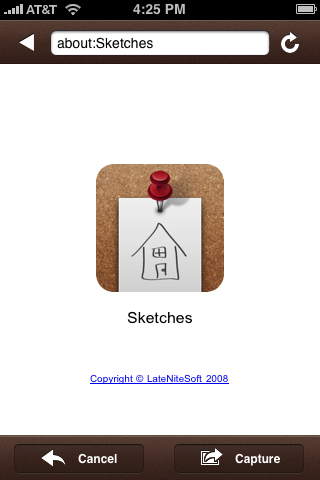
The funny thing is that those two icons have been there since the App Store launch back in July 2008.
What's interesting is that Sketches 1.6 is just a small, bugfix release that was submitted shortly after Sketches 1.5 was approved. Sketches 1.5 added some notable new features (such as our own image hosting service, as described above), and it was approved in just 40 hours. Somehow, improving over the existing feature set has triggered more alarms to fire off than creating new functions in the first place.
Anyhow, we talked to Adam Betts and he sent us a new pair of icons in no time. We created a new build and upload it again. 5 days later, we are still waiting for a response.
The first of these rejections was due to the fact the reviewer was confused about two distinct features: image hosting, and Web sharing. We had updated our application description to reflect the fact that sharing your images via twitter or email causes them to be uploaded to a new web hosting service we have developed anew for Sketches, instead of the former third party service we had been using. It was also explained that the reason for this change was to ensure an excellent quality at all times: we are not interested in placing ads on Sketches' image hosting services; we can act promptly on the event of unexpected downtime; and we can grow the service in the future with new features - none of which was possible with the previous offering.
The Web Sharing feature, on the other hand, allows customers to start a tiny Web server running inside Sketches in your iPhone, then download your pictures in PNG, JPG or PDF from your computer.
After activating the Web Server screen (see screenshot below), the reviewer somehow kept waiting for the drawing to be uploaded to our server. This, of course, never happened, and thus our app was rejected.
When the rejection mail came in, I uploaded the same binary again and wrote back to the reviewer:
"Thanks for your feedback. Uploading to our server is only done when exporting to email or twitter.
What you attached as screenshot, is the integrated web server. That is, Sketches has a Web server that allows you to access your drawings from a Mac or PC using a Web browser, in order to export them. To do so, you simply have to connect to the URL address shown in that screen. In your case, if you open Safari, enter "http://10.0.0.3:8080" [IP address changed from original value] in the URL field. You should get something similar to the screenshot I have attached. Then you can press on the file type you want to export, jpeg, png or pdf, under any of the drawings to obtain a local copy.
I hope this clarifies it. Let me know if you need any further explanation."
A week later, the second rejection email was received. This time, the reviewer had found a true issue, totally unrelated to the previous discussion. Sketches Web capture mechanism used two icons that did not adhere to the iPhone Human Interface Guidelines "as outlined in iPhone SDK Agreement section 3.3.5".
The funny thing is that those two icons have been there since the App Store launch back in July 2008.
What's interesting is that Sketches 1.6 is just a small, bugfix release that was submitted shortly after Sketches 1.5 was approved. Sketches 1.5 added some notable new features (such as our own image hosting service, as described above), and it was approved in just 40 hours. Somehow, improving over the existing feature set has triggered more alarms to fire off than creating new functions in the first place.
Anyhow, we talked to Adam Betts and he sent us a new pair of icons in no time. We created a new build and upload it again. 5 days later, we are still waiting for a response.
Tuesday, December 16, 2008
App Store: Try Before You Buy
Some time ago, I wrote about "The Cruel Economy of the App Store". This article was echoed in TUAW and Business Week, among other media. Since then, Apple has introduced several important changes that will improve both the developers' and the users' experiences:
- Different sorting options per category.
- Multiple screenshots available in the device when browsing the App Store.
- No voting / comments allowed for people who have not purchased or downloaded the application. This will prevent users from leaving destructive, uninformed comments that do not really help other users make purchasing decisions, nor the developer in crafting a better product.
- No shifting in category sorting when updates are released. This avoids confusion to the final users, as they always look at the latest released applications. In addition, it is no longer possible to trick the system with simple, unimportant updates whose main purpose was just to relocate the apps at the beginning of the list.
These changes are very much welcome, and I do believe they are steps in the right direction.
However, the improvements are not enough. The App Store is populating at a very fast rate. When it launched it had around 550 applications, whereas it hosts more than 10,000 today. That is, in only 4 months the number of applications is 20 times what it was at launch, and it continues to grow on a daily basis: according to AppShopper, around 100 apps are added every day.
This rapid growth is a challenge for all App Store stakeholders. First of all, for Apple: they need to manage, review and approve all the new apps and the corresponding update cycles in an efficient and consistent manner, doing so quickly and applying common criteria to similar cases. What's even more important, Apple is probably extremely interested in promoting high quality apps to keep their lead in the thriving mobile computing platform race and once again, they need to do it consistently and coherently to keep their independence. I would anticipate that one of the top priorities for Apple at this point should be to listen to developers' technical feedback, in order to identify potential extensions to the API, evolutions and other improvements. Keep in mind that one of the most anticipated new features in the API -the ability to receive push notifications- was announced long before it was ready, probably to respond to concerns from the developer community about the implications of not having such mechanism.
Developers also need to deal with such a rapid growth: they are seeing their apps drowned in a sea of apps from others, and it is becoming more and more difficult to differentiate their products in the eyes of the customers. Since users would choose what apps to buy based on just a simple description, a screenshot and a price tag, price soon became the single most important mechanism to market your app inside the App Store. As Craig Hockenberry pointed out, the problem now is that there's a strong tendency to lower prices all the way down to $0.99 - as a consequence, not even price will be enough to differentiate apps any more.
Lastly, users suffer from such a formidable response to the App Store in terms of uncertainty. It's fantastic to have literally dozens of competing apps for any interest area; however, users can only see a uniform, flat offer of similar apps with similar screenshots, similar descriptions and similar prices. It's thus becoming more and more difficult to ensure you buy the app that meets your needs the most, or the one you find easiest to work with, or the one that has those little details you love, or the one that launches faster, or the one you think is simply most beautiful.
There are many things that Apple can do to adapt to the new situation, helping users and developers at the same time. As they have already demonstrated, I'm sure they will be working on many areas of improvement; however, I would like to stress what we believe is the single most important missing feature in the App Store: a "try before you buy" mechanism.
Such a mechanism should be part, we believe, of the official SDK. It would allow developers to offer trial versions or trial periods for their products in a snap, since the App Store would handle the specifics of downloading, expiration checking and upgrading. Users would be able to list the applications in trial, with details about how many days there are left and what features (if any) would be disabled if the user chooses not to upgrade. The App Store would allow the user to purchase "the license" that would allow the application to be properly registered and keep operating normally thereafter.
This is a model that has been in place for many years in the shareware market, and is perfectly understood by consumers and developers. An additional advantage of implementing it in the App Store would be the coherence and consistency of the user experience - trial policies, once defined, will be shared by all apps.
Since we are firm believers of this principle, we actually prepared and submitted a special "Sketches Trial" version to the App Store on October 18th. Unfortunately, it was rejected two weeks later, on the grounds that they could not accept our trial because "the application must be a fully functional app and cannot reference features that are not implemented or up-sell to the full version".
From our point of view, our concept was not in conflict with that. Our idea was simply to allow the user to try the application for a few days, without any limitations at all. After the trial period was over, the user could still use some of the features in Sketches, making it act more like a "Sketches Lite" version they would get for free.


What surprised us the most is that the rejection email actually encouraged us to create a free Sketches Lite version, as many others do, but the trial concept was out of the question. What we don't understand is, why is it better to offer a "crippled" lite version, instead of a fully functioning one that some days later transforms into the same lite version? We are proud of the variety of features we've implemented in Sketches while maintaining the ease of use, and we'd like our prospective customers to see and try all of them - that's the only way they can fully evaluate and appreciate the usefulness of the product. In contrast, a "lite" version would necessarily offer a subset of the functionality, and therefore users would get the wrong idea about the capabilities of the product, or they would be constantly nagged about the limitations that do not exist in the full version. We believe those alternatives are clearly inferior.
We believe that the addition of a "try before you buy" mechanism would be a terrific improvement to the App Store, since it will encourage customers to try all the apps they want - hence, sales will be informed ones, satisfaction will be much higher and prices will be easier to match to product features. Our idea to offer our own trial mechanism was clearly an interim solution until Apple delivers global trial capabilities. They are in the perfect position to apply all the well-known shareware practices in a consistent, reliable and easy to use way, and we have no doubt they will be considering this improvement.
We'd like this blog post to be seen as a small contribution towards the improvement of an already awesome platform. If you, as a developer or a customer, agree with us, don't hesitate to express your comments or digg the story :)
- Different sorting options per category.
- Multiple screenshots available in the device when browsing the App Store.
- No voting / comments allowed for people who have not purchased or downloaded the application. This will prevent users from leaving destructive, uninformed comments that do not really help other users make purchasing decisions, nor the developer in crafting a better product.
- No shifting in category sorting when updates are released. This avoids confusion to the final users, as they always look at the latest released applications. In addition, it is no longer possible to trick the system with simple, unimportant updates whose main purpose was just to relocate the apps at the beginning of the list.
These changes are very much welcome, and I do believe they are steps in the right direction.
However, the improvements are not enough. The App Store is populating at a very fast rate. When it launched it had around 550 applications, whereas it hosts more than 10,000 today. That is, in only 4 months the number of applications is 20 times what it was at launch, and it continues to grow on a daily basis: according to AppShopper, around 100 apps are added every day.
This rapid growth is a challenge for all App Store stakeholders. First of all, for Apple: they need to manage, review and approve all the new apps and the corresponding update cycles in an efficient and consistent manner, doing so quickly and applying common criteria to similar cases. What's even more important, Apple is probably extremely interested in promoting high quality apps to keep their lead in the thriving mobile computing platform race and once again, they need to do it consistently and coherently to keep their independence. I would anticipate that one of the top priorities for Apple at this point should be to listen to developers' technical feedback, in order to identify potential extensions to the API, evolutions and other improvements. Keep in mind that one of the most anticipated new features in the API -the ability to receive push notifications- was announced long before it was ready, probably to respond to concerns from the developer community about the implications of not having such mechanism.
Developers also need to deal with such a rapid growth: they are seeing their apps drowned in a sea of apps from others, and it is becoming more and more difficult to differentiate their products in the eyes of the customers. Since users would choose what apps to buy based on just a simple description, a screenshot and a price tag, price soon became the single most important mechanism to market your app inside the App Store. As Craig Hockenberry pointed out, the problem now is that there's a strong tendency to lower prices all the way down to $0.99 - as a consequence, not even price will be enough to differentiate apps any more.
Lastly, users suffer from such a formidable response to the App Store in terms of uncertainty. It's fantastic to have literally dozens of competing apps for any interest area; however, users can only see a uniform, flat offer of similar apps with similar screenshots, similar descriptions and similar prices. It's thus becoming more and more difficult to ensure you buy the app that meets your needs the most, or the one you find easiest to work with, or the one that has those little details you love, or the one that launches faster, or the one you think is simply most beautiful.
Trying
There are many things that Apple can do to adapt to the new situation, helping users and developers at the same time. As they have already demonstrated, I'm sure they will be working on many areas of improvement; however, I would like to stress what we believe is the single most important missing feature in the App Store: a "try before you buy" mechanism.
Such a mechanism should be part, we believe, of the official SDK. It would allow developers to offer trial versions or trial periods for their products in a snap, since the App Store would handle the specifics of downloading, expiration checking and upgrading. Users would be able to list the applications in trial, with details about how many days there are left and what features (if any) would be disabled if the user chooses not to upgrade. The App Store would allow the user to purchase "the license" that would allow the application to be properly registered and keep operating normally thereafter.
This is a model that has been in place for many years in the shareware market, and is perfectly understood by consumers and developers. An additional advantage of implementing it in the App Store would be the coherence and consistency of the user experience - trial policies, once defined, will be shared by all apps.
Our experience - Sketches Trial
Since we are firm believers of this principle, we actually prepared and submitted a special "Sketches Trial" version to the App Store on October 18th. Unfortunately, it was rejected two weeks later, on the grounds that they could not accept our trial because "the application must be a fully functional app and cannot reference features that are not implemented or up-sell to the full version".
From our point of view, our concept was not in conflict with that. Our idea was simply to allow the user to try the application for a few days, without any limitations at all. After the trial period was over, the user could still use some of the features in Sketches, making it act more like a "Sketches Lite" version they would get for free.
What surprised us the most is that the rejection email actually encouraged us to create a free Sketches Lite version, as many others do, but the trial concept was out of the question. What we don't understand is, why is it better to offer a "crippled" lite version, instead of a fully functioning one that some days later transforms into the same lite version? We are proud of the variety of features we've implemented in Sketches while maintaining the ease of use, and we'd like our prospective customers to see and try all of them - that's the only way they can fully evaluate and appreciate the usefulness of the product. In contrast, a "lite" version would necessarily offer a subset of the functionality, and therefore users would get the wrong idea about the capabilities of the product, or they would be constantly nagged about the limitations that do not exist in the full version. We believe those alternatives are clearly inferior.
The Road Ahead
We believe that the addition of a "try before you buy" mechanism would be a terrific improvement to the App Store, since it will encourage customers to try all the apps they want - hence, sales will be informed ones, satisfaction will be much higher and prices will be easier to match to product features. Our idea to offer our own trial mechanism was clearly an interim solution until Apple delivers global trial capabilities. They are in the perfect position to apply all the well-known shareware practices in a consistent, reliable and easy to use way, and we have no doubt they will be considering this improvement.
We'd like this blog post to be seen as a small contribution towards the improvement of an already awesome platform. If you, as a developer or a customer, agree with us, don't hesitate to express your comments or digg the story :)
Thursday, July 10, 2008
Sketches Available on the App Store!
We are extremely excited to announce that Sketches is now available on the App Store, and is highlighted in several countries:

We want to thank everyone who has supported us in this process: Apple, our users, our friends, and particularly, our families.
Sketches Web site is now back. Any comments or suggestions can be posted through the contact form.

We want to thank everyone who has supported us in this process: Apple, our users, our friends, and particularly, our families.
Sketches Web site is now back. Any comments or suggestions can be posted through the contact form.
Tuesday, March 25, 2008
Leopard & Time Machine Experiences

Ever since Time Machine was announced, I had been awaiting for it. I am one of those people that do backup from time to time, but with no regular schedule or automated system. Clearly, Time Machine seemed simple enough and could very well prevent any undesired hiccups.
Once I had Leopard installed on my iMac, I was excited to give Time Machine a try. I decided to buy a Lacie external HD to make the backups. After connecting it, I immediately got a message asking if I wanted to use the disk as a Time Machine disk. I answered positively.
The disk was connected through firewire 800. I left it backing up all night. I took several hours to get all the used space on my iMac HD, a total of 250 Gb, onto the disk. Next day, I launched Time Machine's animated interface. Wonderful. Everything seemed to work fine.
After a some minutes, Time Machine began backing up automatically. This time just a few megabytes. Unfortunately, it took around 15 minutes for something like 3 Mb. In the following days, this became a constant, and I was not happy about it. Backups took way too long. I thought that I had not chosen a good external drive, or that it was faulty.
In addition, my Leopard was not too stable, nor did it operate as fluidly as I was hopping it would. I carefully considered reformatting the iMac with Leopard, and restoring all the user files from Time Machine. I was worried, thought, that the restore process would not work as smoothly as I would want, given the slow backup times and my doubt about the external HD condition.
After some investigation, I found an article that explained how issues might arise for using an APM partitioned drive on an Intel Mac. This could be the cause of my Time Machine troubles. Time for a repartition, reformat, re-first-time-backup.
As my final goal was to get my iMac into better condition, than what the upgrade from Tiger had left it into, I decided that after repartitioning, I would make the external hard drive bootable. I took the Leopard DVD, and using Disk Utility, I "restored" it onto the external hard drive.
Now I had an external hard drive, that used GPT (GUID) instead of the the original APM partitioning, and that was not only bootable, but it had the capacity to install Leopard. Time to try to get all 250 Gb on that disk again. This time it was much faster. It took around 3 hours.
Then, I booted from the external drive. Made a Leopard clean install in around 20 minutes. When the option for transferring files from another Mac was up, I chose to restore from Time Machine. It did it.
Once the restore process finished, most things were fine. As usual, Spotlight started indexing and made the Mac a little bit slow for a while.
After careful examination, I realized that some folders at root level were duplicated. I had "/Applications" and "Applications (from old Mac)". This was true for several others. I deleted all those folders. After all, if I was to need any of those files, they would be present on the Time Machine backup.
Now both Leopard and Time Machine seem to behave reasonable well. I am, though, ready to reproduce this process if I ever need to do so again.
Friday, June 29, 2007
During and After WWDC
We are back from San Francisco. Wow! What an experience.
We started be finding the Moscone building and getting our badges for next day. Then we went to visit Cupertino. This is me in 1 Infinite Loop:

Next day we saw Steve's keynote and learned about how Mac OS X was evolving. During the next few days we learned about different topics. Everything was very well organized and presentations were generally very good. In addition, the opportunity to talk to the Apple engineers was very interesting.
But not everything was nerdy during those days. We met a lot of people, some of whom we only knew virtually (basically through IM). This is both of us with Brian Ball (MacZOT):

These are Sophie Teutschler (Coversutra), Stuff MC (Pomcast) and Pedro, with John Casasanta in the background:

Juan Alvarez and Mathew (Cha-ching):

Austin Sarner and friends:

Skitch's presentation at the Delicious Generation party:

Apple's party:

And we even had some time for touristing around:

Certainly a nice trip. We hope to repeat it next year!
We started be finding the Moscone building and getting our badges for next day. Then we went to visit Cupertino. This is me in 1 Infinite Loop:

Next day we saw Steve's keynote and learned about how Mac OS X was evolving. During the next few days we learned about different topics. Everything was very well organized and presentations were generally very good. In addition, the opportunity to talk to the Apple engineers was very interesting.
But not everything was nerdy during those days. We met a lot of people, some of whom we only knew virtually (basically through IM). This is both of us with Brian Ball (MacZOT):

These are Sophie Teutschler (Coversutra), Stuff MC (Pomcast) and Pedro, with John Casasanta in the background:

Juan Alvarez and Mathew (Cha-ching):

Austin Sarner and friends:

Skitch's presentation at the Delicious Generation party:

Apple's party:

And we even had some time for touristing around:

Certainly a nice trip. We hope to repeat it next year!
Subscribe to:
Posts (Atom)